Upcoming: Light Echoes
October 2, 2026 – January 3, 2027
Biblioteksalen Rundetaarn, Copenhagen
As part of the exhibition series “LYS” marking the 350 year anniversary of the discovery and measurement of the speed of light by the Danish astronomer Ole Rømer.
Curated by Irene Campolmi, the exhibition brings together artists Jo Verwohlt & Pieter Maria Steyaert (DK/BE), Ligia Bouton (USA), Lea Porsager (DK), and Semiconductor (UK). As part of the Art-Science program at the Niels Bohr Institute.
https://www.rundetaarn.dk/en/event/special-exhibitions-in-2026-light/
Interference
Interference was an art exhibition created in collaboration with sound artist Signe Heinfelt. It was exhibited in Nikolaj Kunsthal in February to May 2023.
Interference consisted of eight light and sound installations that was based on the concepts from physics and astronomy on the topic of waves: Standing Wave, Black Hole, Emission, Sound Horizon, Electromagnetic Spectrum, Dark Matter, Sound Paintings, and Evolution of the Universe.
Interference was funded by the Novo Nordisk Foundation.
Standing Wave
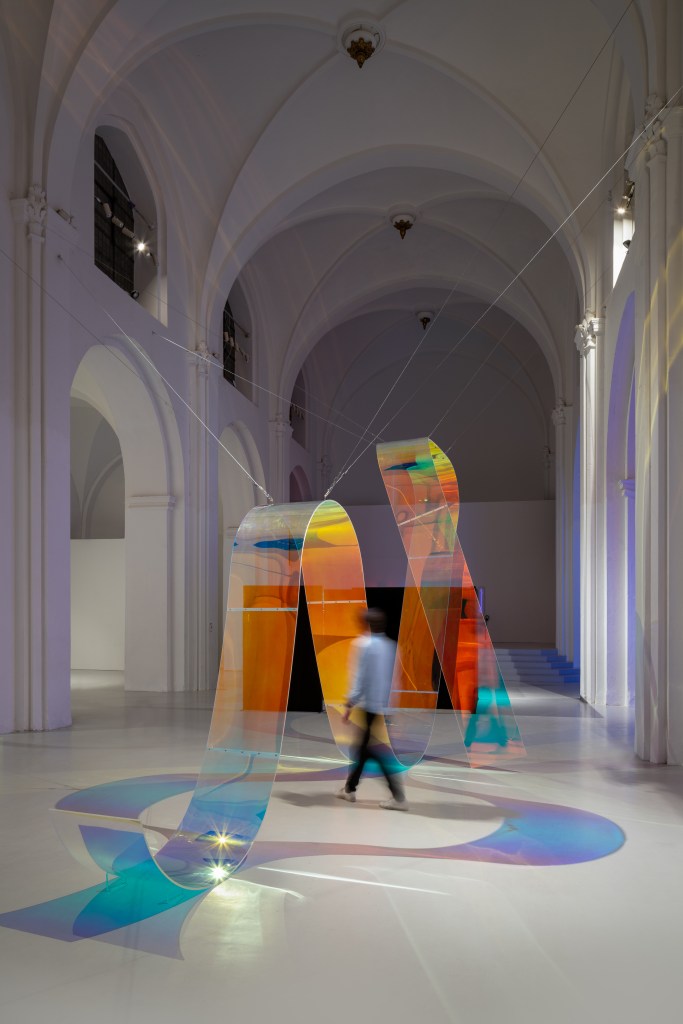
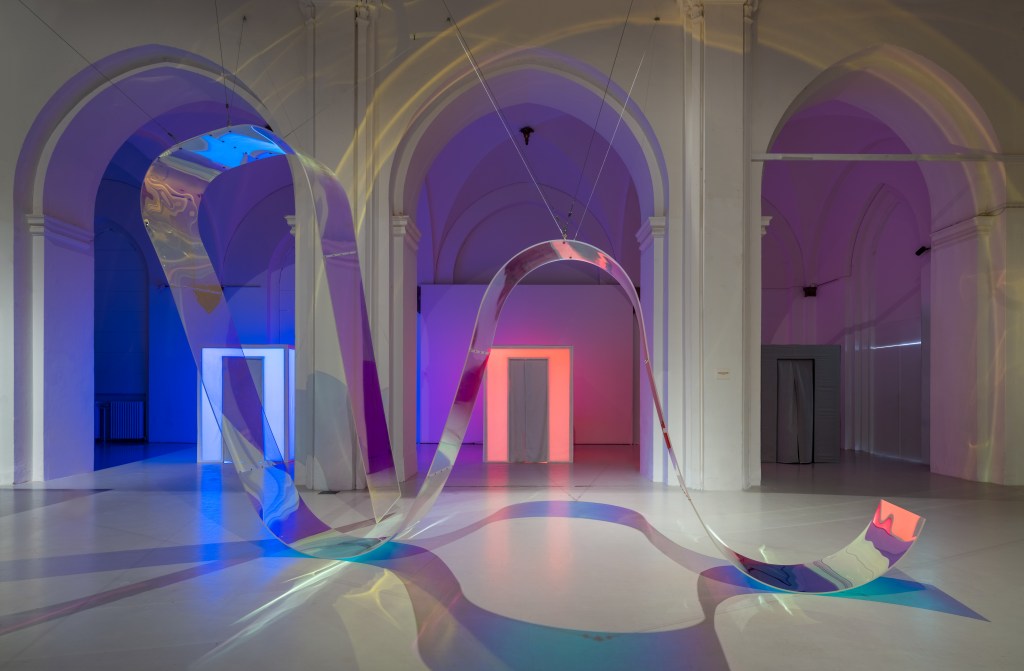
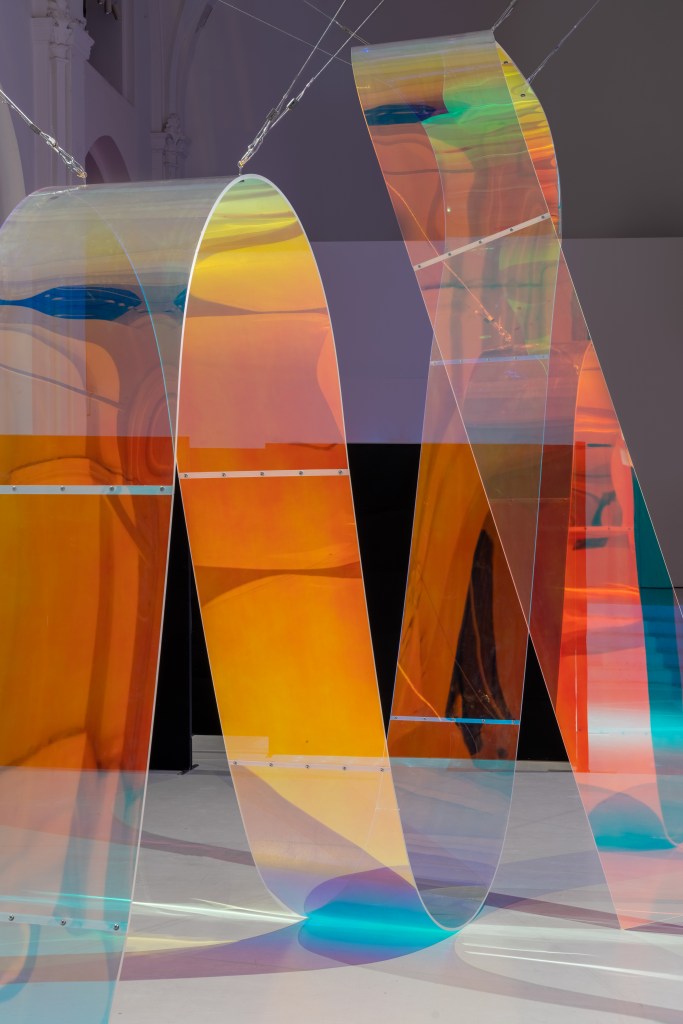
Standing Wave is a large-scale acrylic sculpture that changes shape as one moves in relation to it. The colour-shift is created by attaching an interference filter to the surface of the acrylic sculpture. Standing Wave display how the scientific concept of optics creates beauty in nature. Optics is a fascinating part of physics used to investigate how light interacts with atoms and matter. It plays an integral role in many physical disciplines. Optical phenomena are found in natural beauty such as rainbows, sunsets and opals.
In relation to this exhibition, we cannot mention optics without going into the interference of light. Interference is an optical phenomenon that happens when multiple waves interact and, as a result, create areas of constructive and destructive interference. In constructive interference the light signal becomes stronger and in destructive interference it becomes weaker. This creates a pattern of increasing and decreasing light intensity. White light, such as sunlight, is a continuous spectrum of frequencies. When it passes through a thin film and interferes – the different colours will constructively and destructively interfere at different places, and an iridescent rainbow pattern can be seen. This effect can be seen in e.g. soap bubbles and peacock feathers.

Black Hole
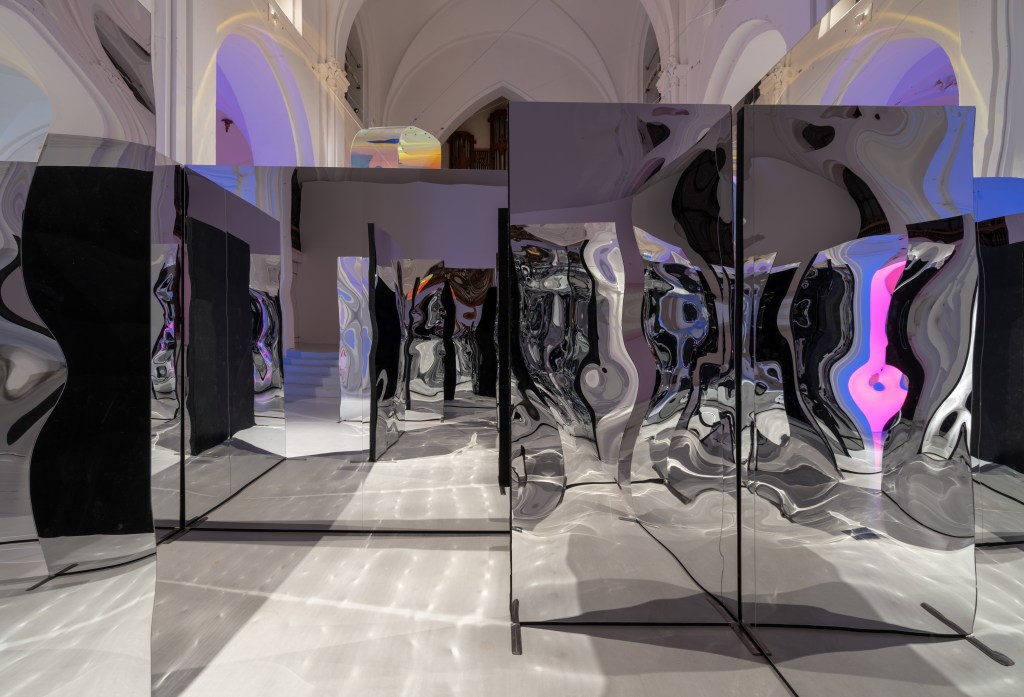
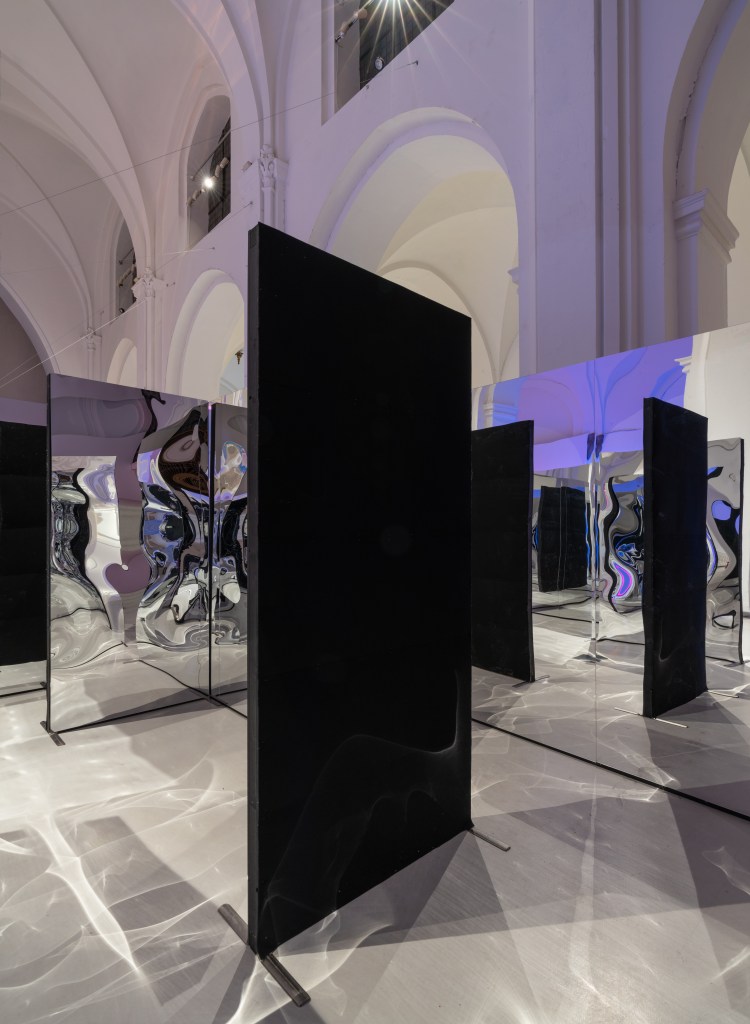
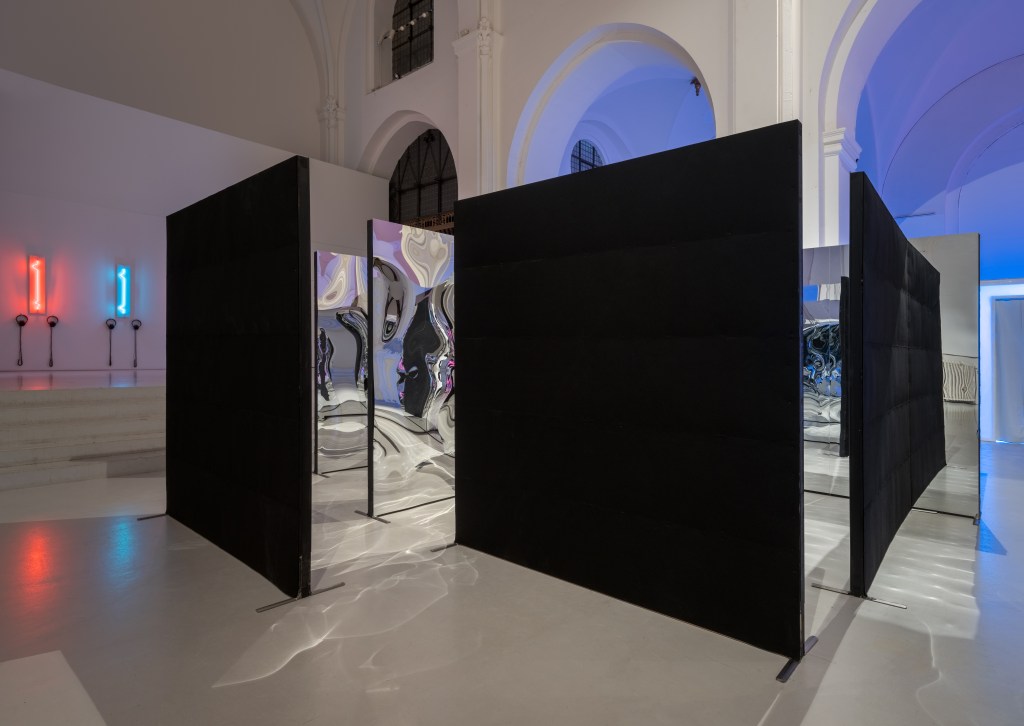
The work Black Hole is created as a fuzzy infinity room. It is made as a labyrinth of mirrors where all entrances lead to the centre. When one stands outside of the installation, the inside is unobservable. There is no clear experienced boundary for when one crosses into the black hole. When standing in the middle, there are mirrors along all lines of sight, and one feels as if all space is contained within the black hole. Inside the installation, the infinity-feel of the mirrors make it difficult to find an exit, and it seems as if there’s nothing outside of the black hole.
Black Holes are perhaps the strangest kind of objects in the Universe. They can be expressed as an actual cavity in space-time that is too steep for anything to escape. Black holes are born from the death of the largest stars. As the dying star collapses under its gravitational force, they leave behind a place where the mass is so large and compressed that gravity is too strong for nothing – not even light – to escape. This region is called the event horizon.
What is particularly interesting about black holes is how they affect space and time. For instance, outside a black hole, we can move freely in three-dimensional space. However, we are forced to move in time with the speed of light. This is how we experience the world and why time appears linear. However, inside a black hole, this behaviour changes; you are forced to move in one direction towards the centre of the black hole and the concept of time breaks down. If you were to travel past the event horizon, you wouldn’t know precisely when you would enter the black hole, but you will never be able to escape. What is even peculiar is that if someone were observing your spaceship, they would never see the spaceship cross the event horizon; it would appear as if it were slowing down and stopping in time.
Emission
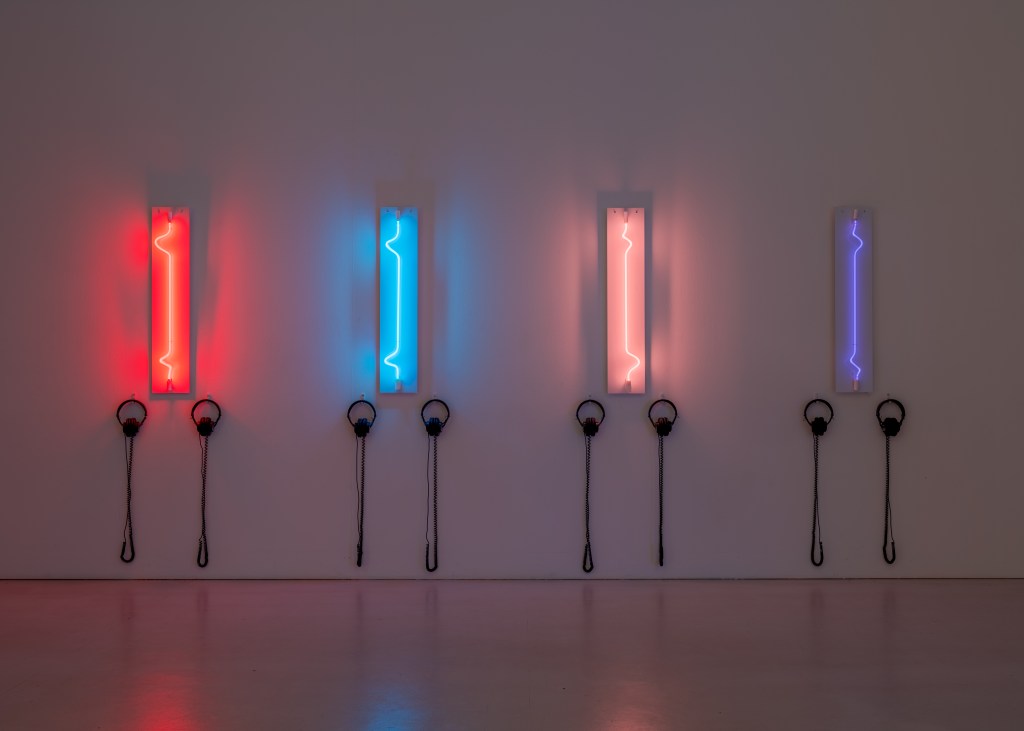
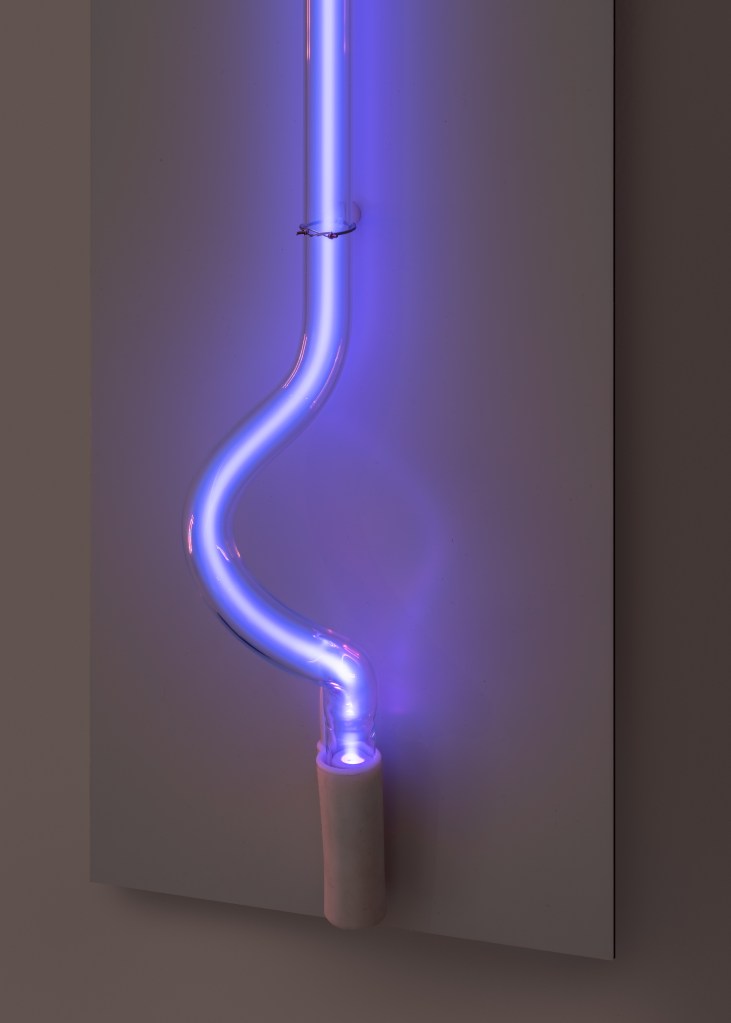
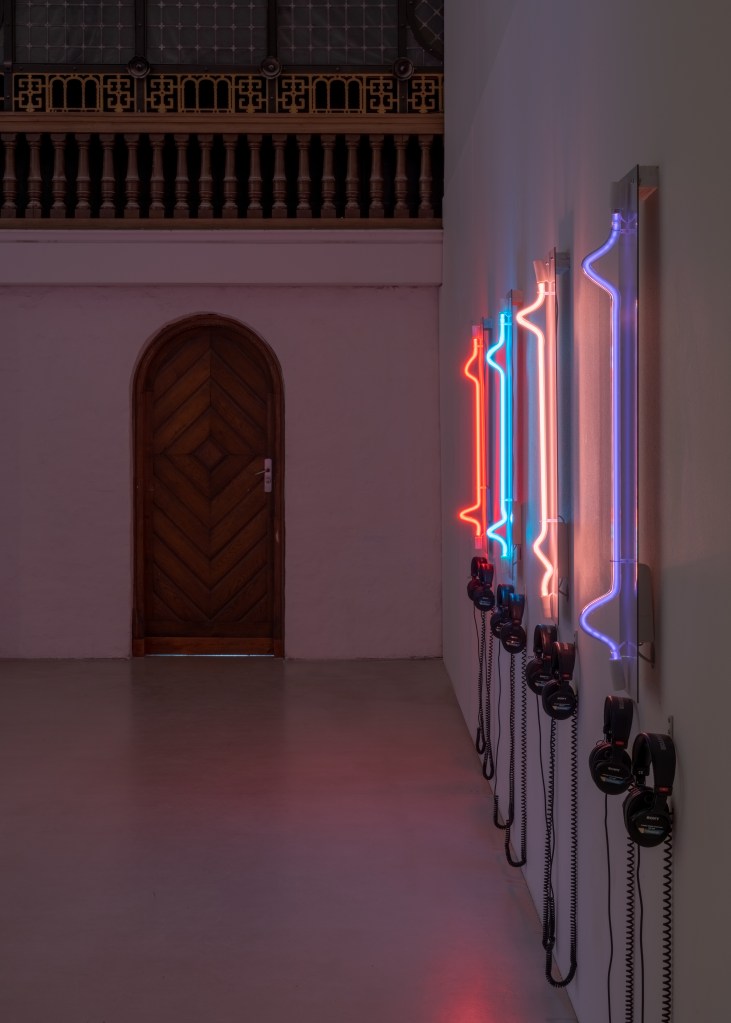
The work Emission is created from four chosen elements: Neon – Ne (red), mercury – Hg (turquoise), helium – He (yellow), and argon – Ar (purple). The work consists of gas tubes that are each filled with the gas of one of the elements. The tubes light up with each element’s unique colour and are accompanied by a sonification of the atom’s spectral lines.
The compositions uses the difference in how our eyes and ears sense frequencies. The eye is not able to distinguish between frequencies in the same location. However, our ears can differentiate between many frequencies at the same time. Imagine how boring music would be if we couldn’t hear the individual instruments and notes but instead we just heard it as one mudded sound? By giving each emission line its own note – it becomes possible to sense how the individual frequencies make up the combined experienced colour.
Niels Bohr’s atom model describes how negatively charged electrons orbit the positive atom nucleus. The model shows us that the electron can orbit the nucleus at specific distances. These are known as energy states and equal different energy levels. The electron can only exist at this precise energy state, never in between. When an electron transitions from a higher energy state to a lower one, the energy difference between the two states is sent out in the form of a light particle – a photon.
This exact energy difference in the form of a photon corresponds to a unique light frequency. A light frequency in the visible spectrum corresponds to a particular colour. There are multiple energy states for all atoms – and every element in the periodic table has a unique set of frequencies. These unique sets of frequencies work as the fingerprints of every element. This is used in astrophysics to characterise elements in the Universe, whether it is in the Sun’s atmosphere, other planets, or in the gas in faraway galaxies.
The human eye does not naturally perform a separation of the frequencies emitted by an element. Instead, the eye perceives the sum of the emitted frequencies as a combined colour the same way a continuous spectrum is perceived as white. For instance, Argon emits a spectrum of red and blue frequencies. If we observe this through a device called a spectroscope, we can perceive the frequencies separately. However, if we look at argon with the naked eye, we see a mix of the colours which results in argon being a purple colour.
Sound compositions
Sound Horizon
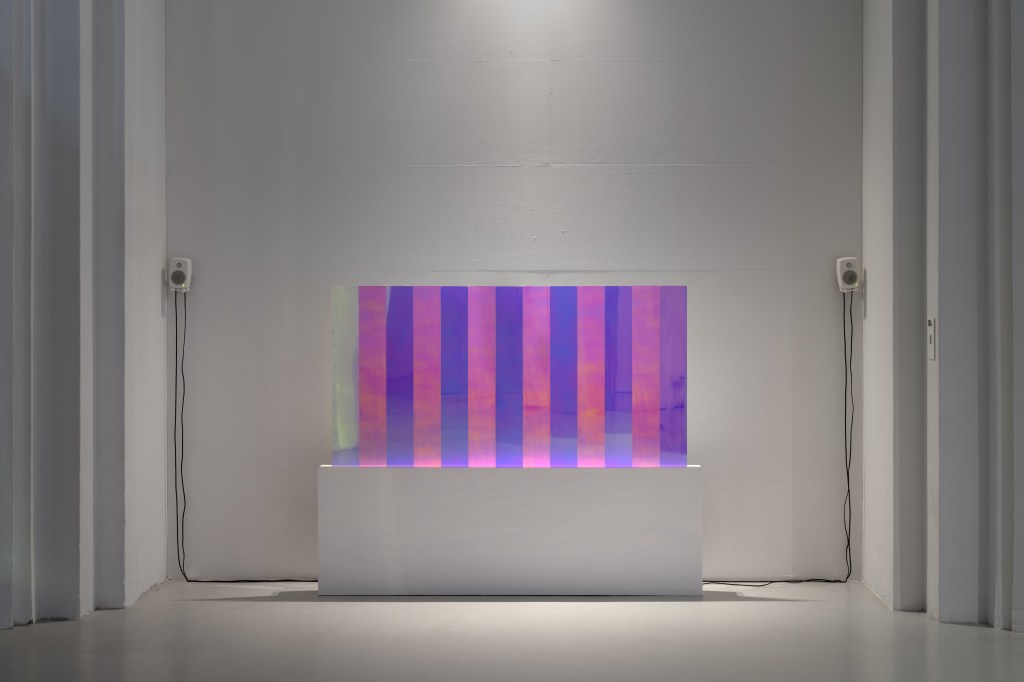
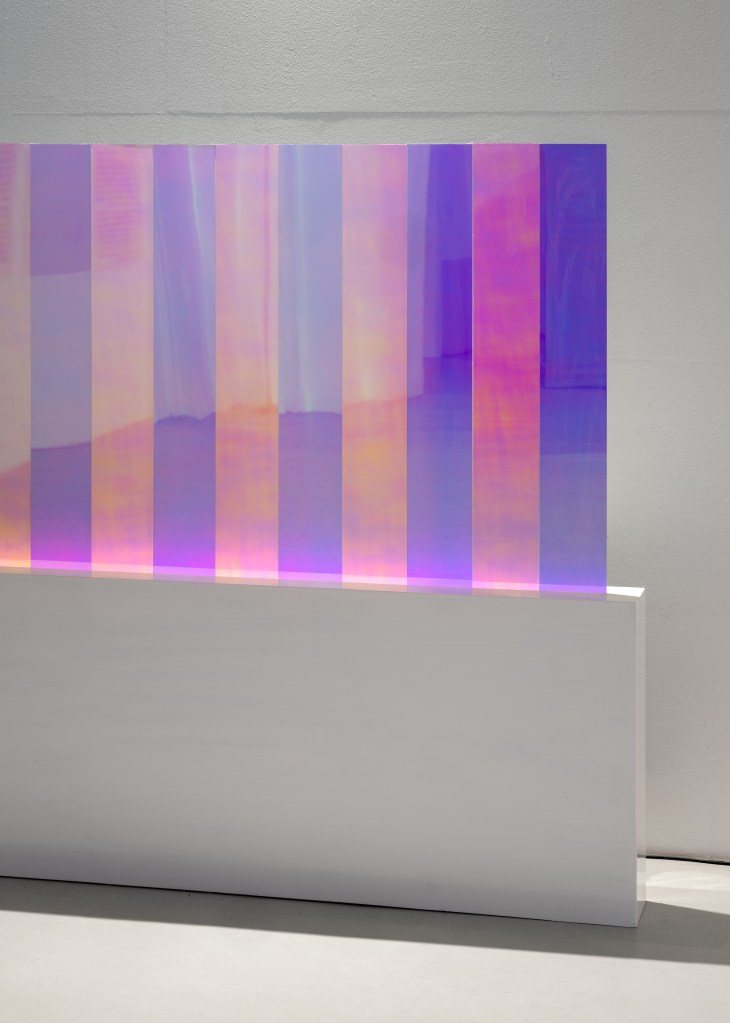
In the work Sound Horizon, 13 polycarbonate plates oscillate between being opaque and transparent to light. This effect is emphasised using a dichroic interference film. This film transmits some colours while reflecting their complementary colours. This makes it seem as if the plates change colour. The visual oscillations are accompanied by sound recordings of oscillating fluids of different viscosities.
The title Sound Horizon refers to the distance which sound could travel in the early times of the Universe when a warm, dense plasma filled space.
The early Universes consisted of a hot and dense plasma. Plasma is a state in which atoms exist, when there is a surplus of energy such that the electrons normally bound in orbits around the atomic nucleus can escape and move freely. Electrons and photons (light particles) interact such that bound electrons obtain energy from photons. Likewise, electrons and photons interact when electrons jump between energy states in atoms and emit light as in emission spectra. In plasma, free electrons also interact with light. Free electrons create an opaque haze that constantly scatters photons such that light cannot travel a significant distance.
In the early Universe, light does not propagate through the dense plasma, but sound waves do propagate through the medium. As the Universe expands, the energy is distributed to a larger region, and the temperature decreases. With time, the Universe has cooled down enough such that neutral atoms can form and the electrons will again be bound to orbits around the atomic nucleus. Light can travel through space, but there no longer exists a plasma for sound to propagate through. There is light in the Universe, but no longer sound.

Electromagnetic Spectrum
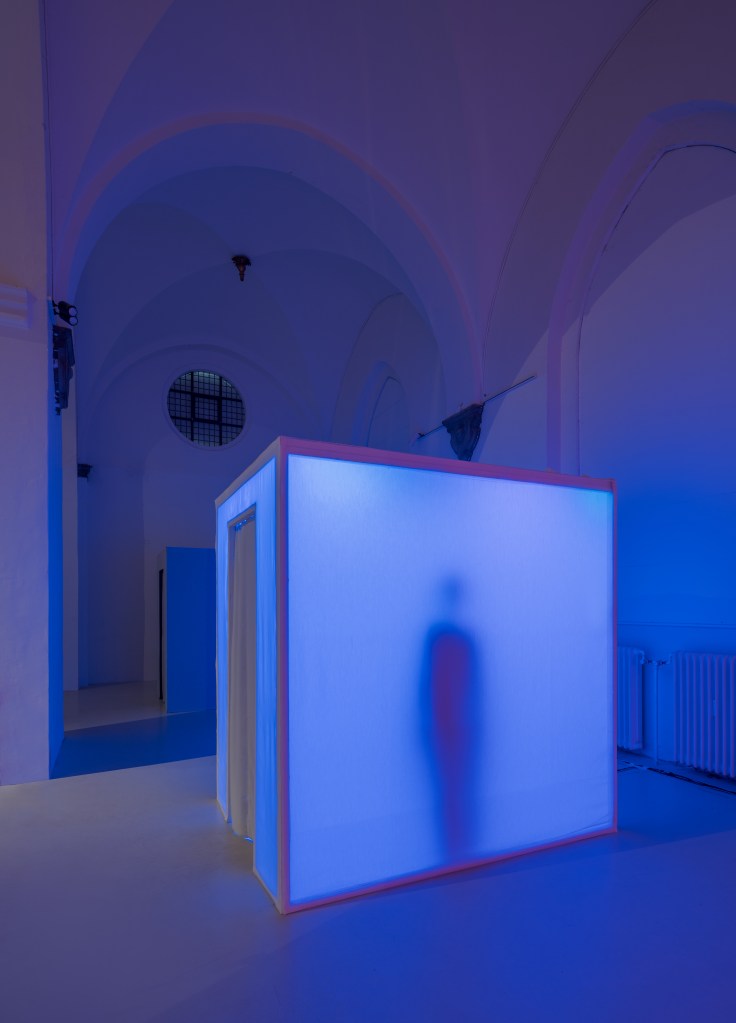
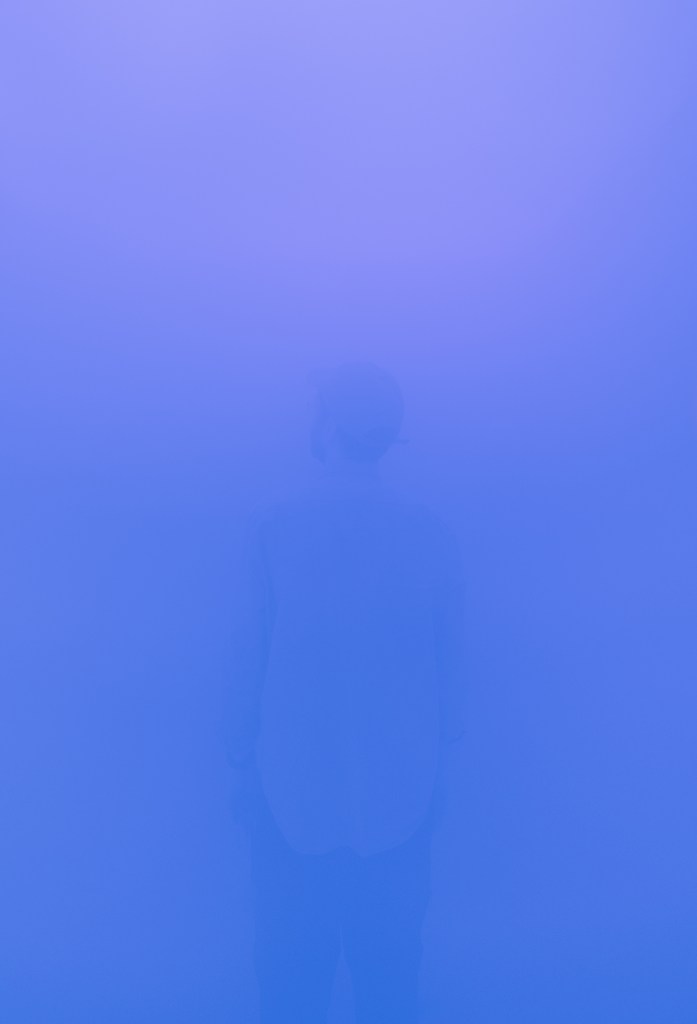
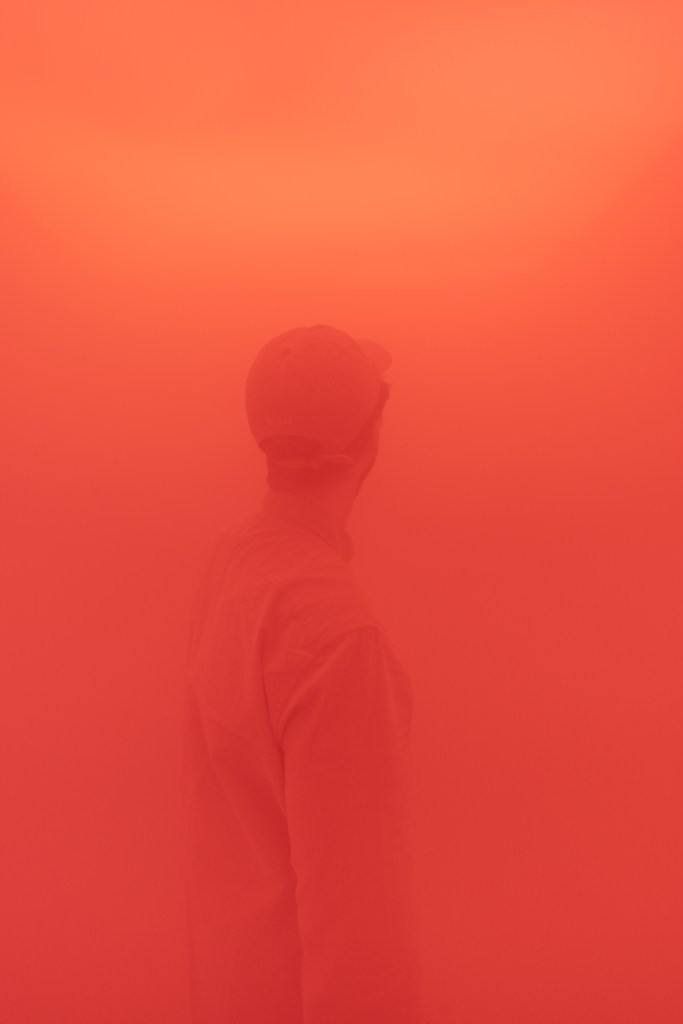
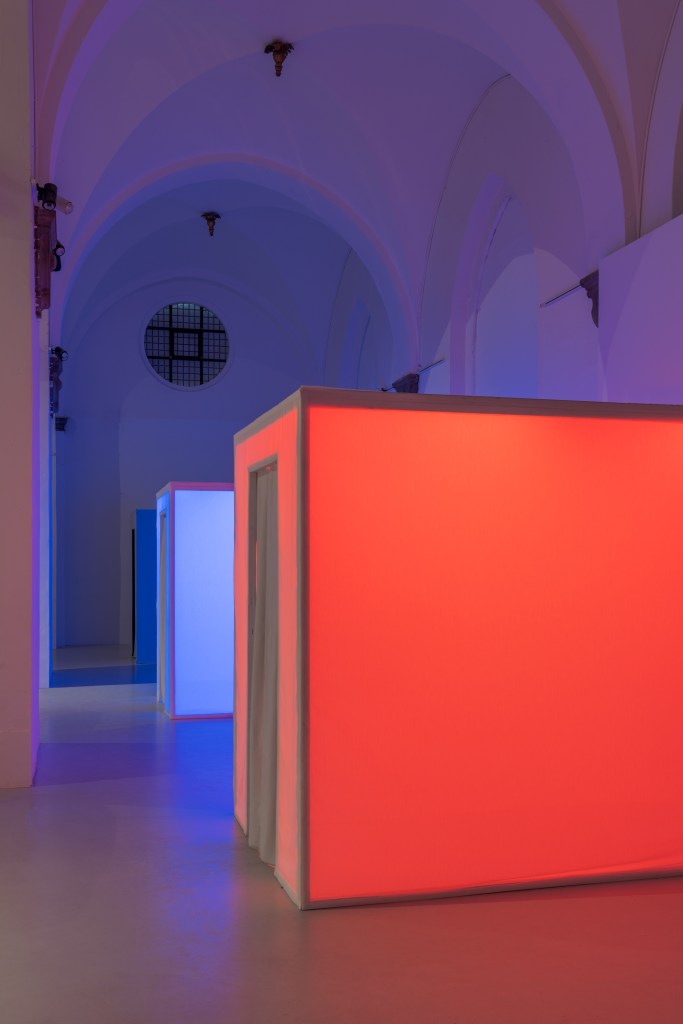
Electromagnetic Spectrum is a series that consists of four different rooms: I (infrared), R (red), B (blue), and U (ultraviolet). The rooms each represent a part of the electromagnetic spectrum of light. Each room is filled with sound composed of the corresponding sound frequencies, making the rooms a synesthetic and immersive experience.
In our everyday life, we might consider light to be the light that is observable by the human eye. This spectrum spans from red at 400 THz (400 trillion hertz) to violet at 700 THz. However, the entire electromagnetic spectrum extends far beyond the visible range. Blue light has a higher frequency than red light, meaning it is higher in energy. Ultra-violet (UV) light has a higher frequency than blue light – and it’s too high for our eyes to observe it. Even higher in energy are X-rays and gamma rays. These are also electromagnetic waves – they are also light waves. At the other end of the spectrum, we have infrared light. This light is of lower frequencies than red light and is too low for us to see. Even lower, we have microwaves and radio waves. The entire electromagnetic spectrum spans from low energy radio waves to high energy gamma rays, where only a narrow part is visible to the human eye.
Even though we cannot see light beyond the visible spectrum, we are still, to some extent, able to sense it directly or indirectly. Infrared light is experienced as heat, X-rays make it possible to see our bones through our skin, and radio waves make it possible to communicate across the globe.
Sound compositions
Dark Matter
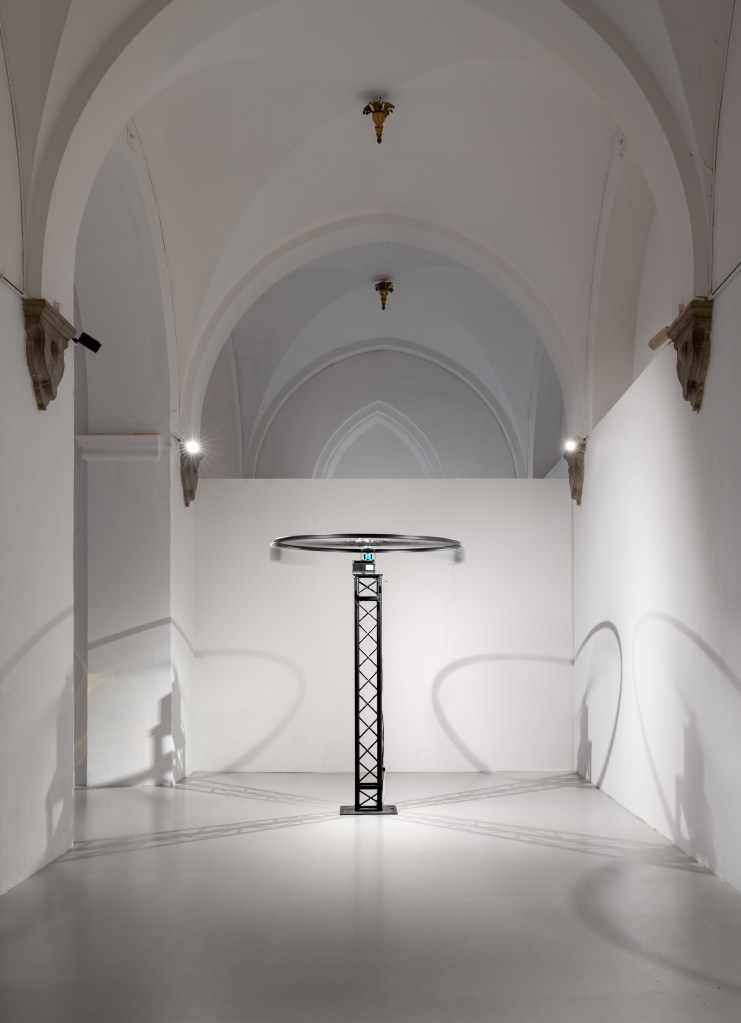
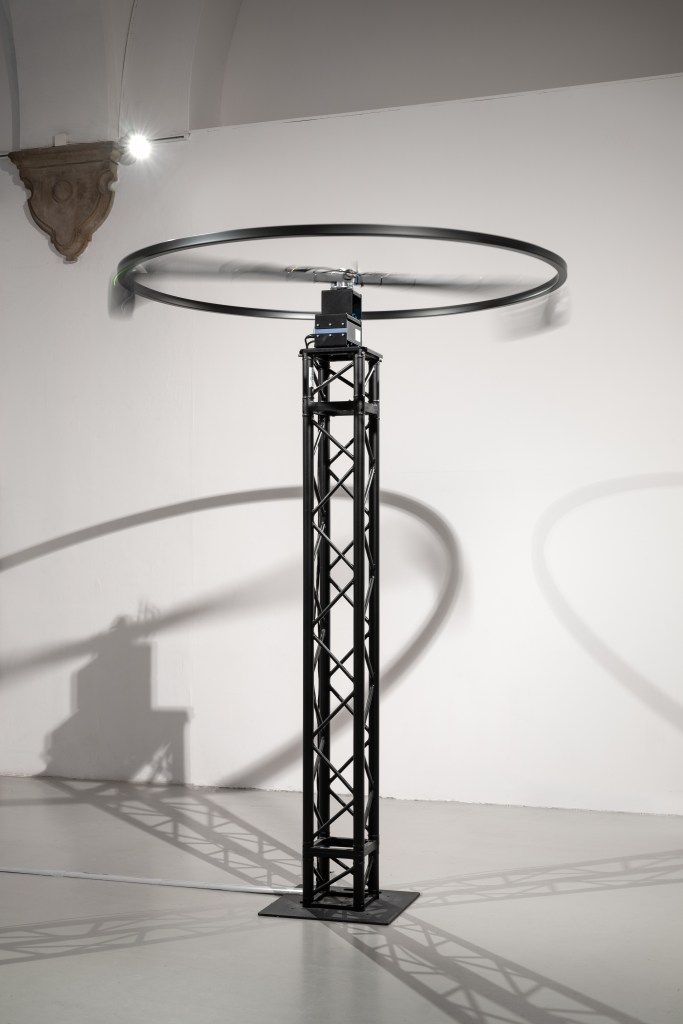
In the work Dark Matter, sound is composed in three dimensions: frequency, time, and rotational velocity. Two loudspeakers are fixed to a rotating wheel with a diameter of two metres. As the wheel rotates, it affects the sound from the loudspeakers and changes the frequency due to the Doppler effect. This means that sound and light frequencies will change with movement in relation to the observer. The music is composed by a sampling of notes from the organ at Nikolaj Kunsthal
The Doppler effect on light cannot be observed at the scales and velocities found on Earth. However, the effect on sound is noticeable and something we are used to relating to. By creating a rotational device inside Nikolaj Kunsthal, the effect becomes very clear. The organ is chosen because it produces some of the cleanest sounds possible without any change in pitch as the pipes are of a definite size and a constant air pressure is applied. There is therefore no vibration in the composition and all vibration audible is due to the rotation.
In 1933, it was identified that galaxies in the Coma cluster were moving much faster than expected due to their mass. Similar effects were observed in galaxies in 1970. The velocity of stars moving around a galaxy depends on the mass within the galaxy. It was expected that the rotation of the stars would slow down in the galactic outskirts as the density of matter decreased, but this was not what was being observed. At the time, it was thought that galaxies mostly contained stars and gas, but it seemed that some mass component was missing from the galactic picture.
This missing mass is what we now know as dark matter, and it turned out to be a critical component that has shaped the Universe as we know it. Dark matter makes up about 85% of the mass in the Universe, and it is the glue that holds the structures in the Universe together. Despite its importance, we still do not know what dark matter is.
Rotation in a galaxy can be measured by how the emitted light from the stars is blueshifted and redshifted. This phenomenon is known as the Doppler effect. The Doppler effect occurs when a source that emits waves moves in relation to the observer. We often experience this phenomenon when an ambulance drives past us. We hear the siren as if it’s changing in pitch, but it’s actually the same frequency that is emitted. The pitch appears to change due to the movement of the ambulance.
The amount of dark matter that exists in a galaxy affects its rotation. The more dark matter a galaxy has, the faster it will rotate. This increased rotation will result in a more prominent Doppler effect
Sound Paintings
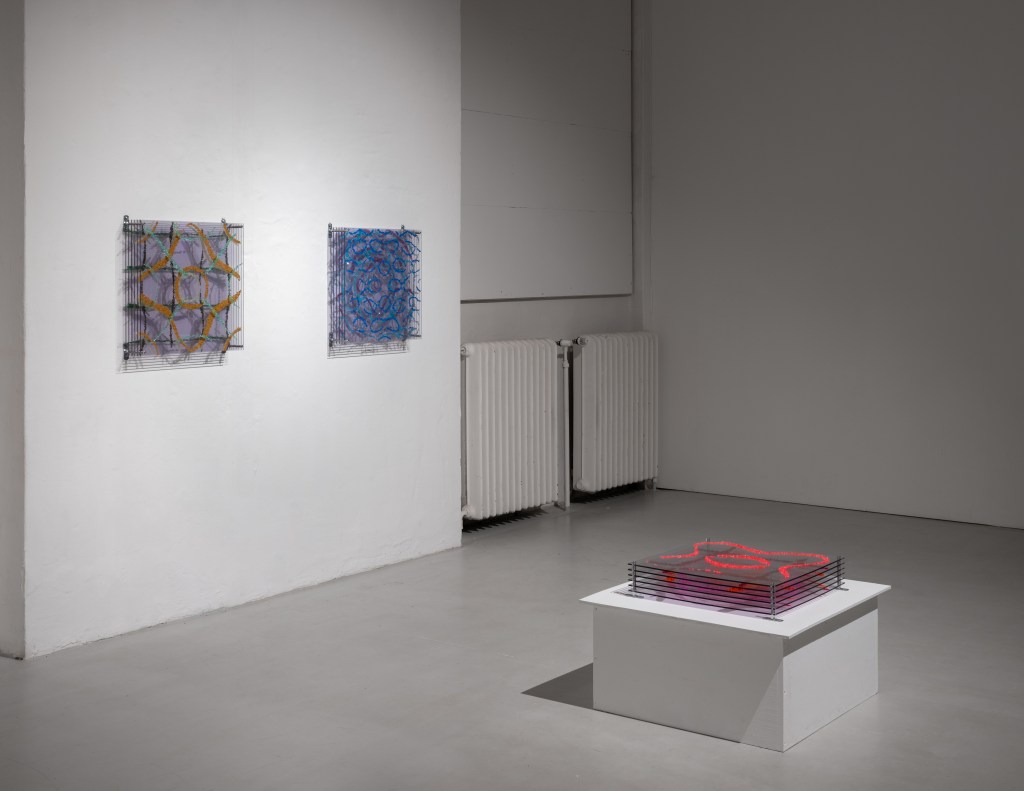
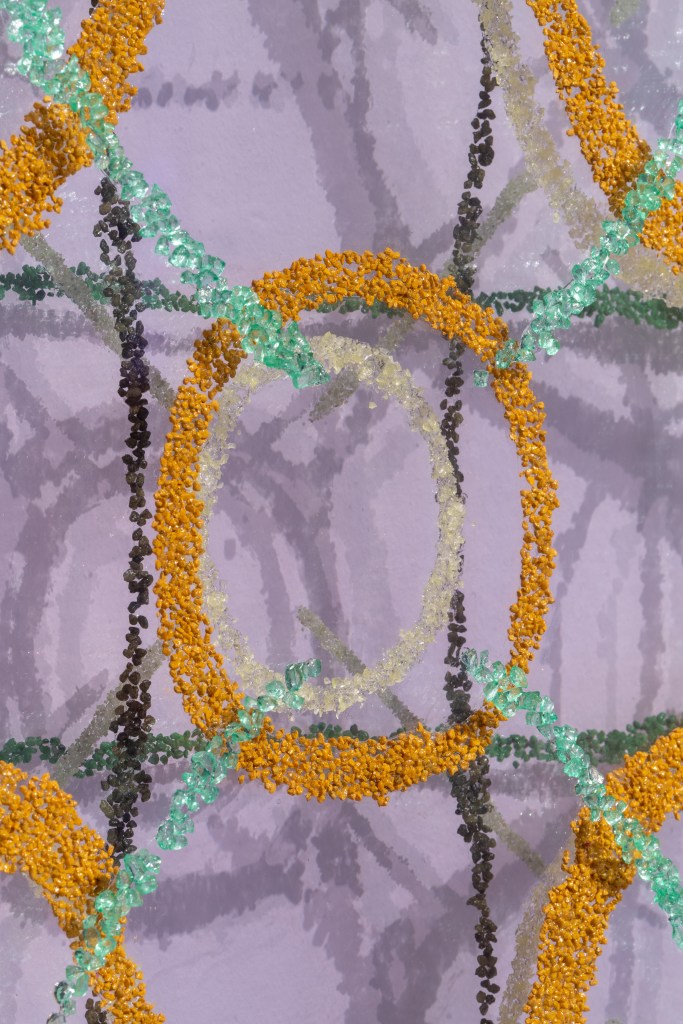
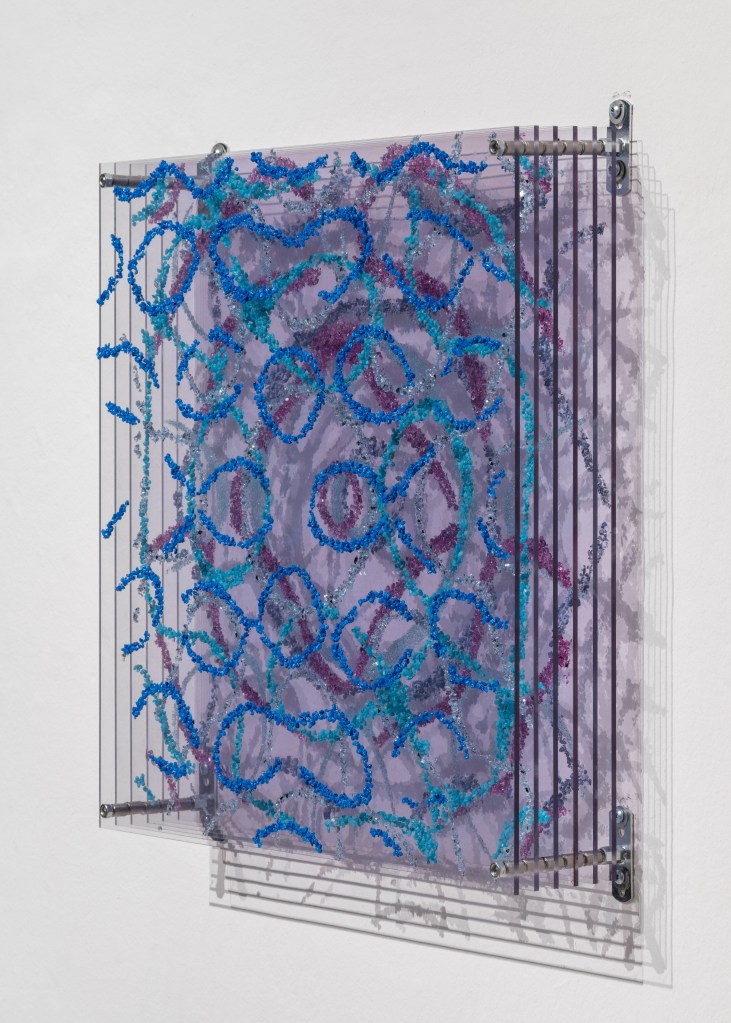
Sound Paintings consists of three 3D images that show Chladni patterns of sound waves in a frequency range from 160 Hz to 9713 Hz – almost the entire spectrum of audible sound. Each image is made from six polycarbonate plates arranged from lowest to the highest frequency with silicates (sand, glass, rocks) in synthetic colours., forming the different Chladni patterns of each frequency.
The three 3D images are represented as a low, medium and high frequency image. The associated colours are in line with the electromagnetic spectrum such that the low-frequency image is red, the medium is green, and the high is blue.
Sound waves are mechanical waves that propagate by setting a medium into motion. Chladni plates were invented by 18th century German physicist and musician Ernst Chladni and show how sound vibrates through materials and create patterns and nodes that correspond to particular sound frequencies. As the frequency increases, the patterns become more complicated. However, not all frequencies create a pattern. Only the eigenfrequency of the plate as well as the top notes, have a corresponding pattern.

Evolution of the Universe
Evolution of the Universe is a sound piece composed by Signe Heinfelt and Mariam Gviniashvili. The composition is ambisonic, meaning it can be experienced spatially in three dimensions. The composition tells the history of the Universe that started with the big bang about 13.8 billion years ago and presents a possible future ending of the Universe.
The first half of the piece is composed by Signe Heinfelt and covers the epochs from the big bang to recombination when light could travel through space for the first time. The second half is composed by Mariam Gviniashvili and tells the story from recombination to a hypothetical future ending.
Electromagnetic Spectrum R + B
Electromagnetic Spectrum R and B was reinterepreted and exhibited as part of SEADS’ (SPACE ECOLOGIES ART AND DESIGN Network) and Theater Neumark’s immervise theatre experience EXOMOON in Zürich in September 2023.
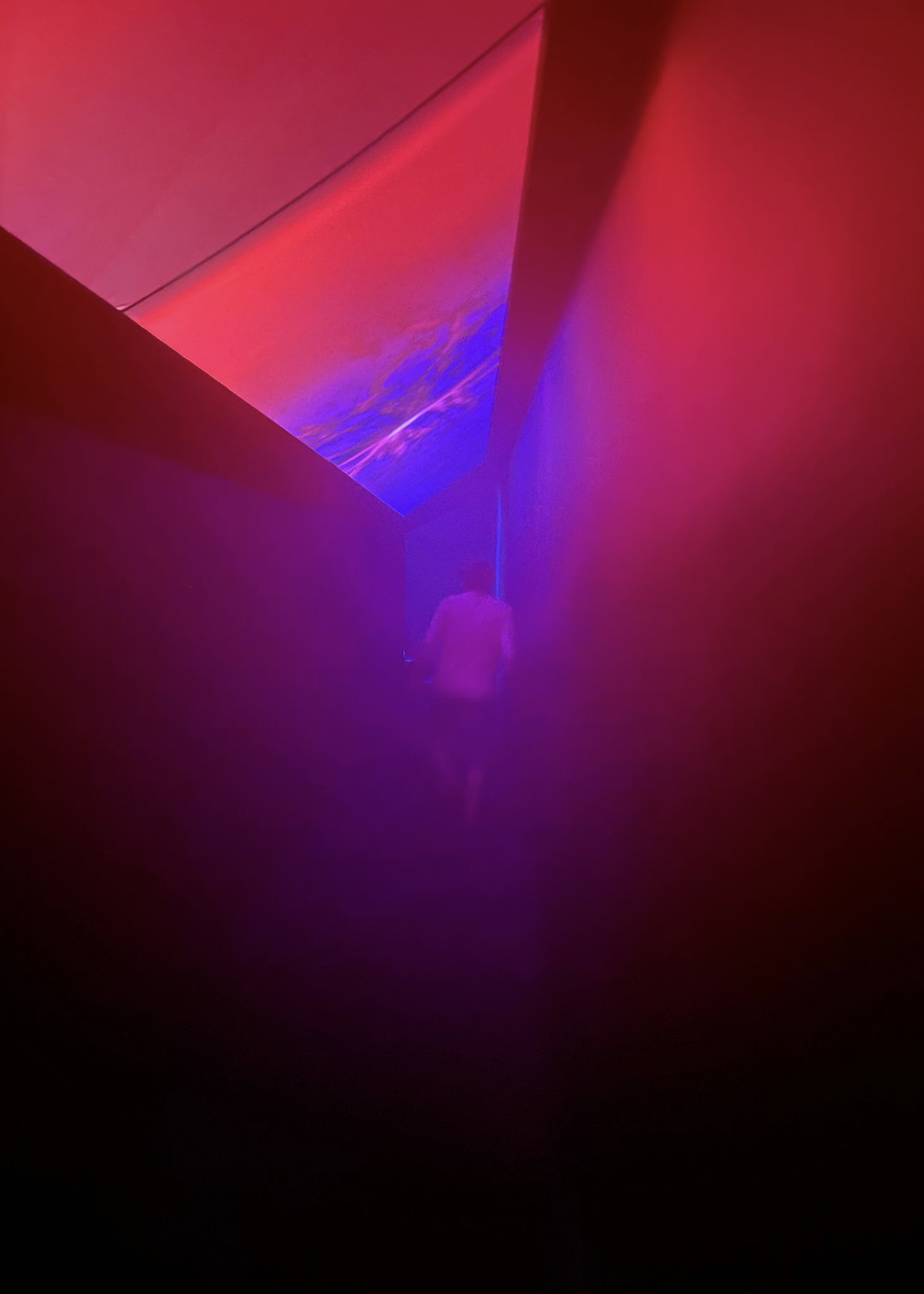
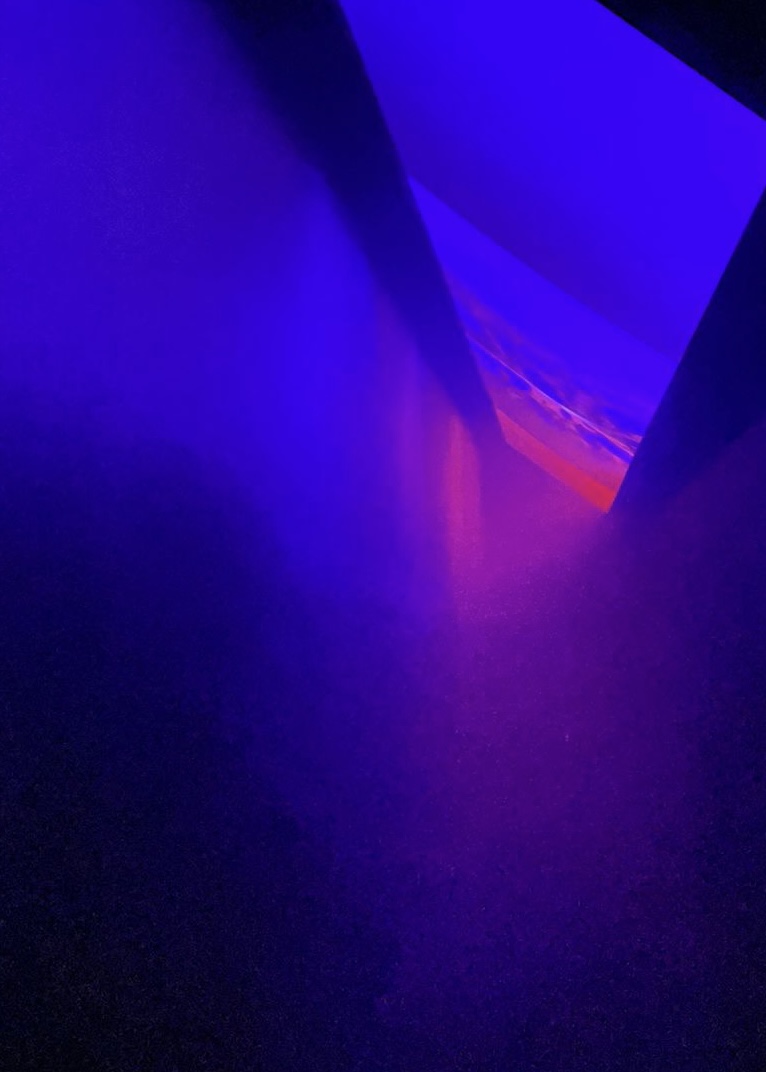
Photos by David Stjernholm
 Jo Verwohlt